From Rosé to Doechii, there’s no shortage of unforgettable backsides featured in “Behind Every Original,” the latest global brand campaign from Levi’s®. Among them is an homage to “The Boss” himself, American singer-songwriter Bruce Springsteen and his “Born in the U.S.A.” album — and of course, his iconic Levi’s® 501® jeans.
On a brisk New Jersey day this January, I took a trip to visit the soon-to-be-open Bruce Springsteen Center for American Music at Monmouth University, not far from Asbury Park, Bruce’s early stomping grounds. Opening this June, the Center kicks off with an exhibition celebrating America’s 250th and includes artifacts from Bruce’s career, like his legendary album-gracing Levi’s®. Melissa Kozlowski, director of Curatorial Affairs, gave me a tour and allowed me to take a closer look at one of the most recognizable pairs of denim in American history.
Read on for my “down to the stitches” review of Bruce’s britches.
A Recognizable Backside
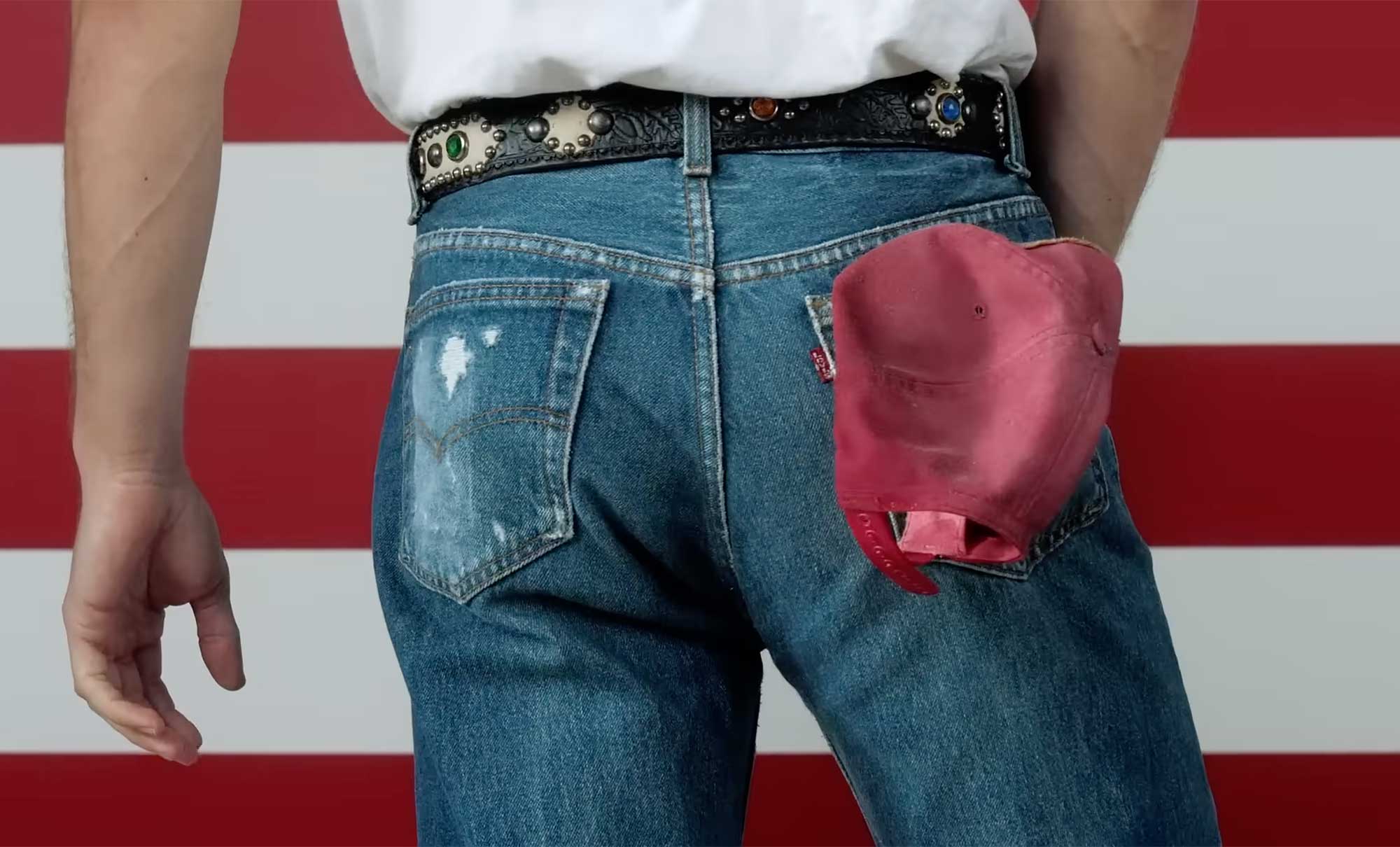
Bruce’s 1984 album cover features a photo of the Boss’ backside set against red and white stripes that appear to be an American flag. We see Bruce’s white T-shirt, a studded leather belt and a hanging out of his right back pocket (read Melissa’s fascinating story about Bruce’s hat).
In a 2014 interview, longtime Bruce Springsteen and E Street Band drummer Max Weinberg explained why he voted for that photo to be the album cover: “[M]ost of them featured Bruce’s face. There were a couple of cars with some people in them. And then there was this one shot of what became the album cover. And I voted for that one because that was the view I always saw … I’ve only seen [Bruce] from the back,” he joked.
Big “E” Red Tab
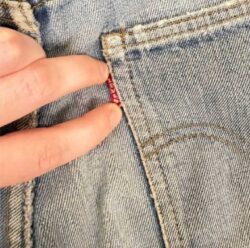
I first saw Bruce’s 501® jeans at the Rock & Roll Hall of Fame in 2016, where they were displayed just like his album cover with the back side visible. The red Tab on the right back pocket appeared as if it had been cut off close to the pocket.
When Springsteen Center staff took a closer look, they found the red Tab rolled up and carefully flattened it back out, revealing the “LEVI’S®” spelled out in all capital letters. This hidden detail was my biggest surprise find. The big “E” red Tab, along with the lack of rivets on the back pockets and lack of any inside care labels, place Bruce’s Levi’s® between 1966 and 1971.
In short, Bruce’s “Born in the U.S.A.” jeans were already more than 10 years old when they appeared on the cover of his 1984 album. His iconic Levi’s® were not only worn well, they were also well-worn.
Made in the U.S.A.
Like Bruce’s album title, Levi’s® jeans were born in the U.S.A. — invented in the American West and made with 100% American cotton strengthened with the addition of copper rivets. They were first worn by blue collar workers — the kind Bruce often sang about — who needed pants tough enough to withstand the demands of their day-to-day work.
The blue jeans featured on Bruce’s cover — a pair of button-fly faded blue Levi’s® 501® jeans — were also born in the U.S.A., specifically at a factory in El Paso, Texas, that opened in 1966.
The back patch on Bruce’s Levi’s® is missing, but we can guess the size from another pair of Bruce’s Levi’s® that sold at auction in 2022. Size 31×32, the black jeans were often worn by Bruce during his “Born in the U.S.A.” Tour in 1984 and 1985.
Selvedge
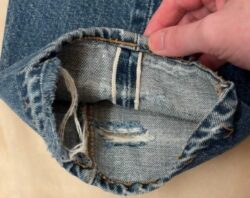 A quick look under the hem revealed the selvedge on Bruce’s Levi’s®. It was also a good place to see the original blue color of the jeans. The dark blue indigo color pops against the white selvedge line, highlighting how faded the 501® jeans have become on the frontside.
Around 1984, the year Bruce released “Born in the U.S.A.,” Levi Strauss & Co.’s denim supplier, Cone Mills, adopted a modern and more economical wide loom in response to the increasing demand for denim around the globe. With the new loom, denim was cut down in the middle, doubling the width of its denim and eliminating the selvedge.
Knowing this, there was a chance that Bruce’s Levi’s® did not have any selvedge. I was happy to see it there — although there was no sign of the red line, which must have faded.
Lived in Levi’s®
In addition to the make and material, a few other characteristics stood out to me when reviewing Bruce’s “Born in the U.S.A.” Levi’s® 501® jeans:
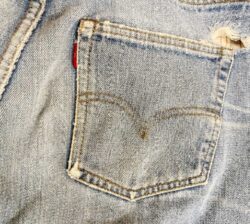 Notable wear and tear: The jeans are torn on the front of both knees, with threads barely hanging on. A large hole at the top corner of the right back pocket reveals the white pocket bag underneath, the front pocket scoops are threadbare from constant use and there is a round tear in the back left pocket above the Arcuate stitching, clearly recognizable from the album cover. At the bottom leg of the jeans, the yellow stitching is unraveling and the hem is slowly coming apart in several sections.
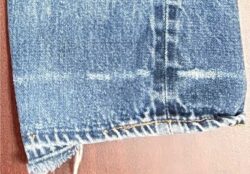 Visible cuff lines near the hem: One of the photos not selected for the cover shows a full front shot of Bruce wearing his Levi’s®. Cuff lines are visible on the jeans above black Frye boots.
- Signs of a favorite
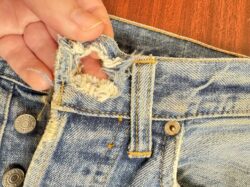 pair: Bruce must have buttoned and unbuttoned his Levi’s® countless times, and the denim reflects that. The top buttonhole on the fly is shredded, the waistband is extremely worn and there are many areas of discoloration and staining. The entire left back pocket is more faded than the right and there is brown staining near the belt loops, presumably from a belt.
“These jeans have so many signs of wear and tear that it is easy to say that he wore these regularly and only stopped wearing them when they simply could not go on in their condition,” shared Springsteen Center staff. “Suffice it to say he got A LOT of use out of these jeans.”
And that’s the backstory behind an American Original’s jeans — no nonsense, hardworking, enduring. Just like The Boss.
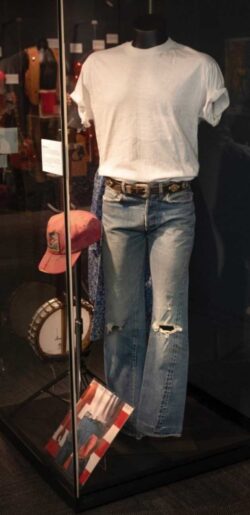
Bruce’s Levi’s® jeans on display at “Music America: Iconic Objects from America’s Music History“
Stitch-Level Summary for Denim Heads
- Levi’s® 501® jean dating between 1966 and 1971
- Made in the U.S.A
- Selvedge Denim
- Big “E” Red Tab
- Estimated Size 31×32
- Condition
- Shredded top buttonhole
- Staining, especially at waistband
- Heavily faded
- Front knee tears
- Back pocket tears and holes
- Stitching threadbare on front pocket curve
- Cuff lines
- Hem unraveling