LS&Co. Unzipped

Welcome to our blog. Here’s where you’ll find a “behind-the-seams” look at what’s going on with Levi Strauss & Co. You’ll hear from a variety of voices, from both inside and outside the company. And you have the chance to share your thoughts. So read on — and weigh in!

Apr 17 2012

The People Who Make Our -- Your -- Clothes

What’s good for people can be good for business. That’s our approach.

Think about it. If apparel workers are healthy and take pride in their work, that’s good for them, their families, and their community . . . and, chances are they’ll do a good job.

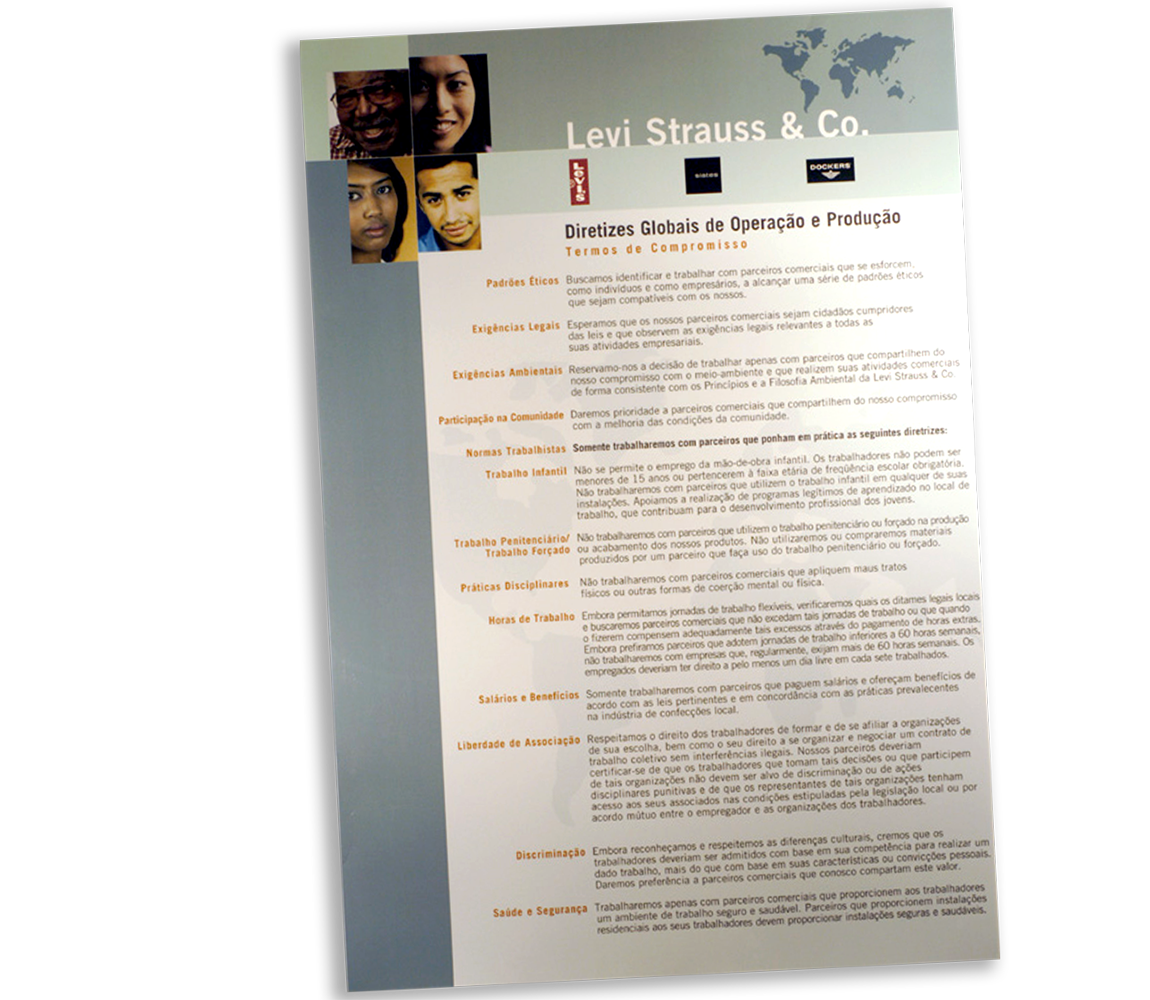
That was the thinking, more than 20 years ago, behind our Terms of Engagement, the labor, health, safety and the environment requirements for our supplier factories to protect the people who make our garments. If a factory wants to make Levi’s®, Dockers® or Denizen® product, they have to abide by our standards.

Now, we’re building on those standards by piloting a new approach with factories. The idea is to support programs that will improve the lives of workers within and beyond the factory walls.

Today, we’re releasing a research paper with Ceres, which lays out this new approach. A separate one-page document provides a brief overview.

As the chief supply chain officer at Levi Strauss & Co., I manage the sourcing of our products from around the world. I’m also responsible for making sure our products are made in a way that aligns with our longtime approach of “profits through principles.”

We already know that improving factory conditions makes business sense. BSR’s HERproject (Health Enables Returns), a worker program the Levi Strauss Foundation supports in China, Egypt, India and Pakistan, showed that for every $1 invested in women’s health education, $4 of savings was delivered in Egypt. That’s good for people and for business.

Over the past year, with the help of Ceres and BSR, we convened industry stakeholders, other companies and NGOs to share knowledge and start the conversation on what is needed to make this vision a reality.

We know that we don’t have all the answers. And we learned that we need better data on what workers actually need. That’s why, as part of the pilot program, we’re charting new territory by conducting worker surveys that will help understand their needs and aspirations, and also set a benchmark for progress.

And we’re collaborating with our suppliers to launch a pilot program in five factory sites – one each in Bangladesh, Cambodia, Egypt, Haiti and Pakistan. In these locations, we’ll be developing programs tailored to the needs of each workforce.

We know that we can’t do this alone. We invite you to join us on this path to further demonstrate that what’s good for people … is good for business.
Editor’s Note: We will be discussing our path forward with other companies, NGOs and investors at the Ceres Conference workshop – Great Expectations Building a Sustainable Supply Chain on April 25th in Boston – come join us!

White Paper

Click the image to download Improving Workers' Well-Being Research Paper.

Posted By: David Love, Chief Supply Chain Officer, Levi Strauss & Co.

Bookmark and Share


Tags: Levi Strauss & Co.,Social Responsibility


Before posting your comment, please read the Blog Guidelines.

Moana (not verified) - Apr 26 2013

I am sickened by the wages made in Bangledesh and elsewhere and the end price in the store. I almost exclusively buy Levis and roots products as I was under the impression (misguided) they were made in north america. How in your mind, in your companys conscience (I heard corporations are people in the USA) can you exploit people in poor countries? I am cycnical now of "ethical washing" just like the bogus green washing of some products. So I am telling you as a long time consumer here in Vanocouver, bring the factories home! the minium wage here is 10.25 an hour, if it takes one hour to make a shirt or pair of jeans and it ends up as 80.00 in your stores is that difference enough for your overhead? How long does it take to make a pair of jeans or shirt?

Editor's note: Hi Moana, and thank you for your comment. We do produce some of our product in North America, but the majority is produced elsewhere. With our product sold in some 110 countries around the country, and to compete in a global market, we work with suppliers around the world. Our commitment is to make sure those suppliers provide safe working conditions for the people who produce our products. We were the first multinational apparel company to implement a code of conduct for suppliers who wanted to work with us. I invite you to read more here, on this same website. Ensuring the health and safety of the people who make our clothes is a critical concern for us, and we're continuing to work to build on our commitment.


Michelle Stevens (not verified) - Apr 22 2012

I started wearing Levi 501's in 1986 when I was in high school. Since then that is only type of jeans I buy/wear. However over the past several years since u stopped making them in the USA they definetly aren't made as well, they don't fit as well and they absolutely do not last as long. So my question is this , why not bring the business back to the USA. You'll have a better product and you'll be helping OUR economy ?

Editor's note: Hi Michelle. Thanks for your comment. We sell our products in 110 countries around the world, and we produce our jeans globally, as well. We do have product that is "Made in the USA." You'll find it in our stores and on our website. In addition, no matter where it's made, our product is backed by a manufacturer's warranty against defects. If you have a problem with one of our products, I encourage you to contact Consumer Relations


Post new comment

The content of this field is kept private and will not be shown publicly.
By submitting this form, you accept the Mollom privacy policy.

Before posting your comment, please read the Blog Guidelines.

We welcome your comments.

When submitting a blog comment, please consider the following guidelines:

  • Focus on the topic
  • Be constructive and considerate
  • All submissions are subject to the terms set forth in our Terms of Use

This is a moderated blog. Each comment will be reviewed. We reserve the right not to post your submission if it’s off-topic or contains any of the following types of content or violates other guidelines:

  • Obscenities, discriminatory language, or other language not suitable for a public forum
  • Advertisements, “spam” content, or references to other products, offers, or websites
  • Email addresses, URLs, phone numbers, physical addresses or other forms of contact information
  • Critical or spiteful comments on other posts on the page or their authors

In addition, if you wish to share feedback with us about product selection, pricing, ordering, delivery or other customer service issues, please do not submit this feedback through this blog. Instead, contact us here.