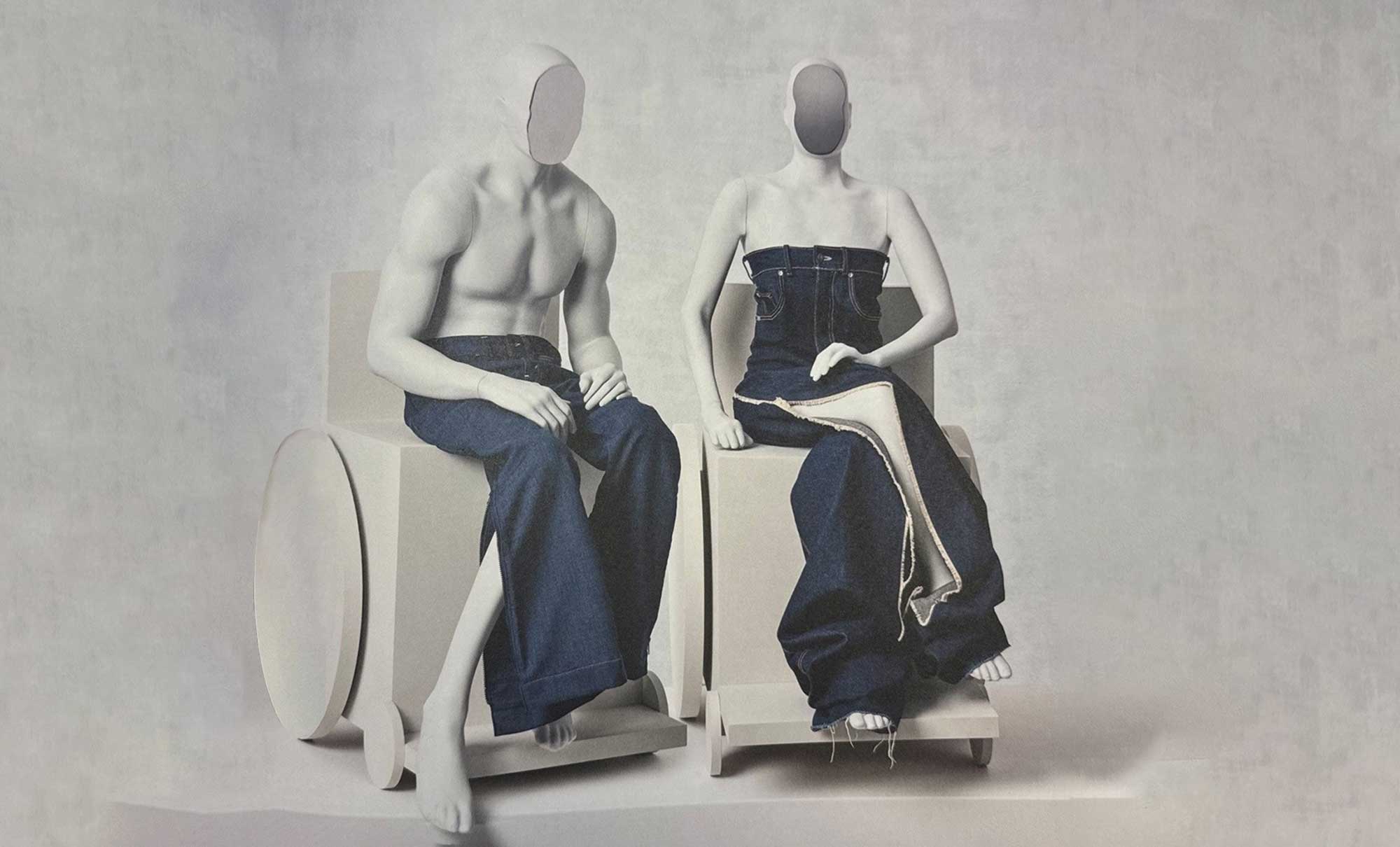
“Costume Art,” the latest fashion exhibition at The Metropolitan Museum of Art in New York City, explores fashion on diverse body types as a form of living art. One of the 200+ garments on display is a pair of 1970s Levi’s® disability jeans from the Levi Strauss & Co. Archives.
The Story of the Levi’s® Disability Jeans
The Levi’s® disability jeans, a garment from the innovative Functional Fashions line, were designed just as blue jeans were exploding globally in the early 1970s. The popular denim styles were flying off the shelf, purchased by people around the world — except for those in wheelchairs. The problem was that the stiff denim pants were not practical for wheelchair users to wear.
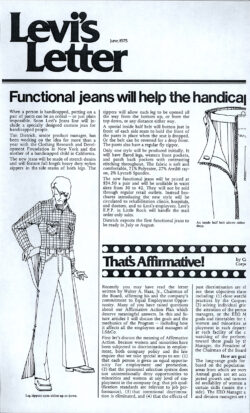 That’s when the Levi Strauss Foundation funded the groundbreaking work of Helen Cookman, a deaf designer who had patented “Trousers for a Handicapped Person.” By 1975, LS&Co. settled on a design and offered the functional jeans directly to consumers through special-order brochures at doctors’ offices, hospitals and rehabilitation clinics.
The Levi’s® disability jeans were produced in stretch denim and fabricated with full-length zips at the side seams that opened from the top or bottom and stopped anywhere along the seam. A half belt in the same fabric was added to the waistband, buttoning on either side of the waist to hold the jeans in place when the seat dropped. The belt could be reversed for a front drop. The jeans were also designed with a roomy seat and easy-to-reach pockets.
For the wheelchair user, the pants were extremely functional. To the casual observer, the pants looked like just another stylish pair of flared Levi’s® jeans.
Inside “Costume Art”
The Met’s impressive exhibit, which spans 300 years of Western fashion, takes a futuristic approach to displaying garments. One key concept of “Costume Art” is to create a portion of the mannequins using real bodies with real lived experiences to “elicit a discernible aesthetic appreciation rooted in life and imbued with truth.”
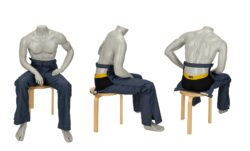
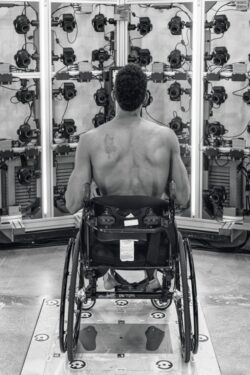
This meant that the Levi’s® jeans are displayed on “mannequin art” — a mannequin cast made from a 3D scan of model and wheelchair user Antwan Tolliver, founder of FREEDOM IS FLY. Antwan was one of nine models scanned to create 25 mannequins of diverse body types. The mannequins were also fitted with mirrors for faces.
“I’ve never had so many cameras on me at one time,” Antwan said. “I was like, wait, this looks like how video games are created. It was so cool.”
Each garment on display is also paired with a piece of artwork. For the Levi’s® disability jeans, the paired art is “Street” (2018) from “Revelations in a Wheelchair.” The black and white photo taken by Nolan Trowe, the recently disabled New York City photographer, shows the inside of an elevator from someone seated at wheelchair height.
If the Met’s exhibition was intended to mark a turning point in representing and appreciating costume art and fashion in a museum, then including Levi’s® could only further this goal of realism. After all, Levi’s® denim has been at the center of culture, including the intersection of fashion and art, and is one of the few global fashion items worn by people of all backgrounds and ages — and abilities — all over the world.